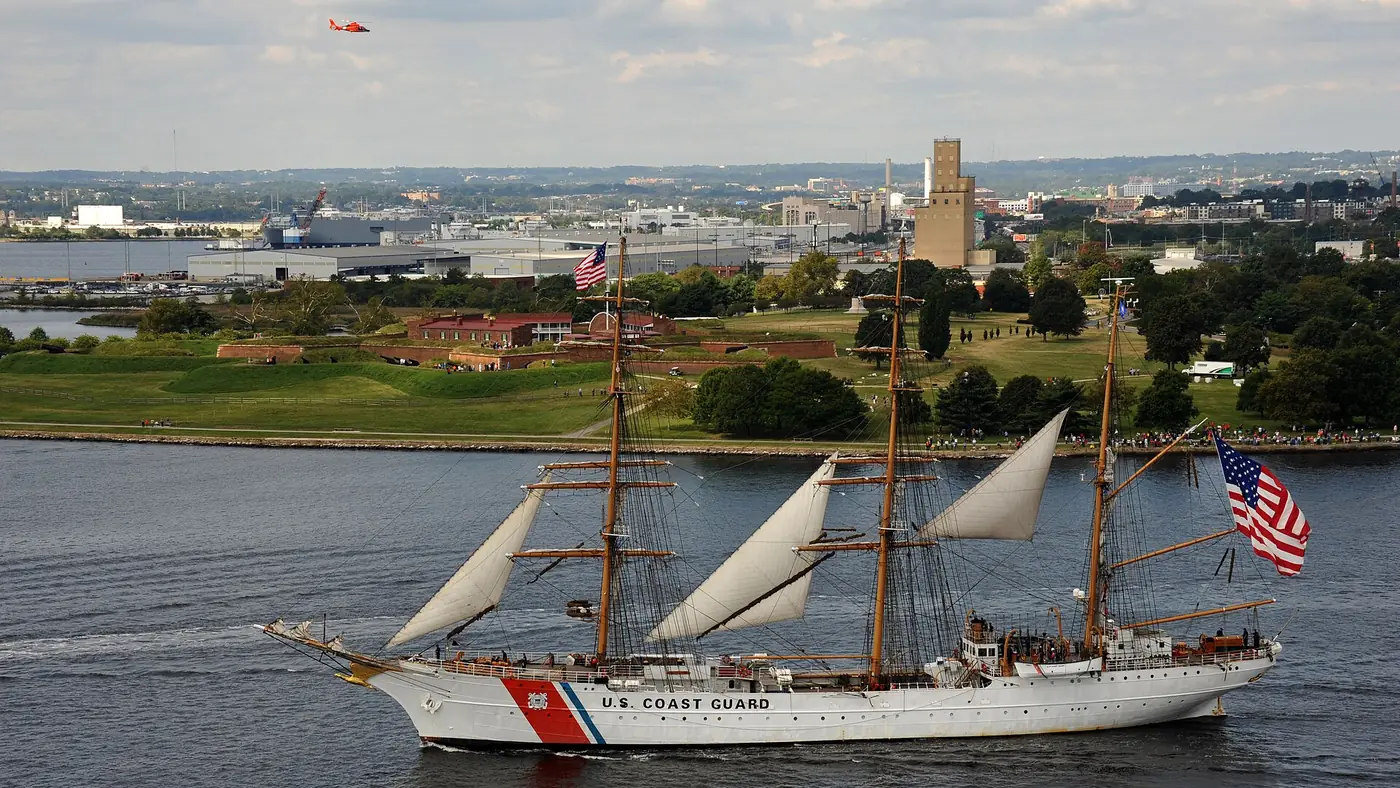
Booking choice: The Inner Harbor sightseeing cruise, from $34 per person. Check dates Tour details
Fort McHenry is two places in one. Outside the wooden fence is a free park: the visitor center with its museum and film, lawns, statues and the seawall trail. Inside it, for $15 (adults 16 and over), is the star fort that held off the Royal Navy in 1814, ringed by the outer battery and its Civil War-era cannons.
Below is a walk-through in the order most people see it, then the practical part: restrooms, food, kids, wheelchairs and dogs. The facts come from the Park Service's own pages, checked in October 2026.
The quick answer
Start at the Paul S. Sarbanes Visitor Center for the free museum and 10-minute film, then walk to the star fort ($15, 16+) for the barracks, the powder magazine, the Civil War cells and the flag change. The cannons on the outer battery are original Rodman guns from the 1860s. Finish on the free, mile-long seawall trail. There is no café, so bring a picnic for the West Lawn.
What is there to see at Fort McHenry?
The visitor center museum and film, the star fort with its barracks and powder magazine, the outer battery's cannons, the reconstructed water battery, the Orpheus and Armistead statues, and the seawall trail.
Our suggested order, with rough timings:
| Stop | Cost | Allow | Don't miss |
|---|---|---|---|
| Visitor center and museum | Free | 20 to 30 min | The last seconds of the film |
| Star fort | $15 (16+) | About 1 hour | The flag change, the powder magazine, the cells |
| Outer battery | $15 (same pass) | 15 min | The 15-inch Rodman guns |
| Seawall trail | Free | 30 min | The river view the defenders had |
| Orpheus statue and lawns | Free | 10 min | The picnic tables on the West Lawn |
The whole visit takes about two hours, as the hours guide explains, and the tickets guide shows exactly where the fee line runs.
Is the Fort McHenry film worth seeing?
Yes, see it first. The free orientation film tells the story of the battle and the anthem in about 10 minutes, and at the end a window wall is uncovered with the fort and its flag beyond.
It runs every 30 minutes from 9:00 a.m. to 4:00 p.m. in the Paul S. Sarbanes Visitor and Education Center, which opened in 2011. Seating is very limited, so on a busy day queue for the next showing rather than the current one. The film is closed-captioned. It has surround-sound cannon booms and low-rate flashing lights, and the museum lights dim while it plays: warn small children.
The museum around it covers the War of 1812, the Battle of Baltimore and the anthem. The bookstore and gift shop sell books, flags and souvenirs; you can also buy a U.S. flag to be flown over the fort and get a certificate with the date. Water bottle filling stations and restrooms are here too.
After the film, see the same walls from the water: the Watermark cruise passes the point in 45 minutes.
Check dates for the Inner Harbor sightseeing cruiseWhat is inside the star fort?
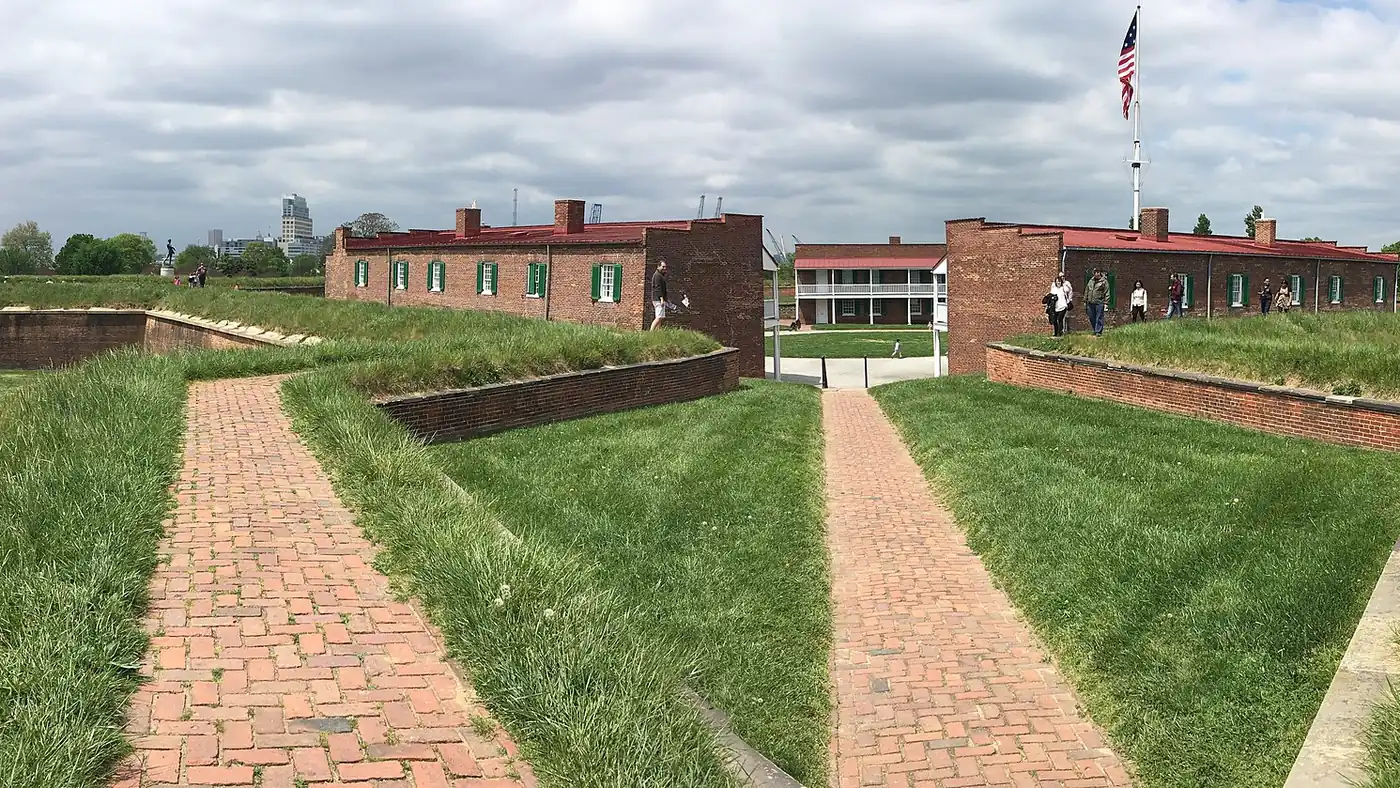
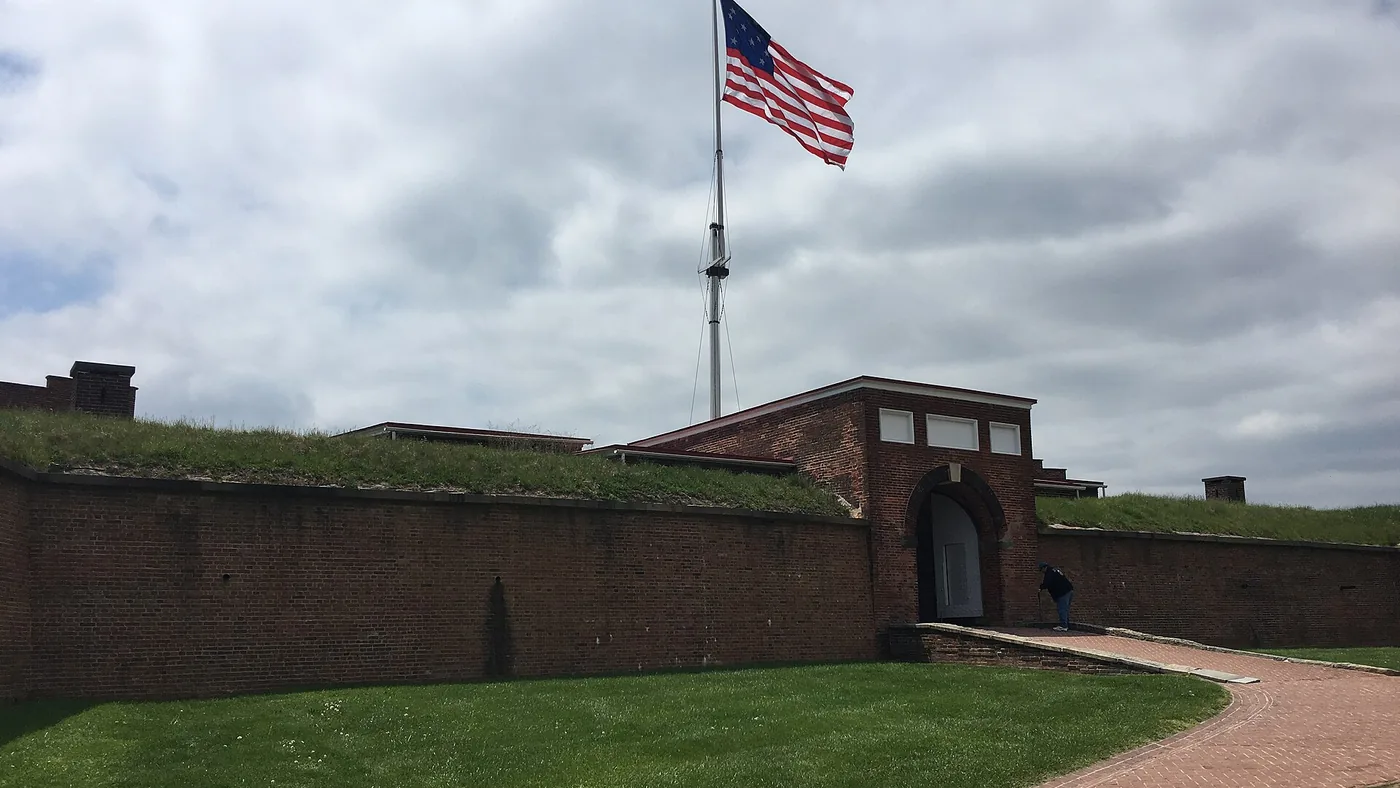
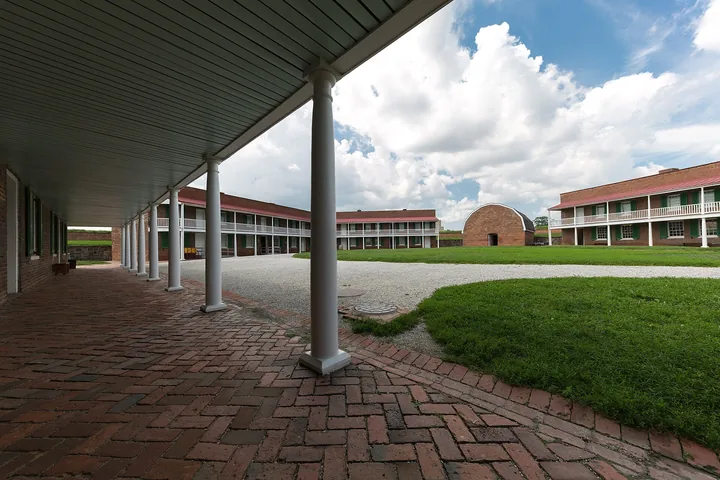
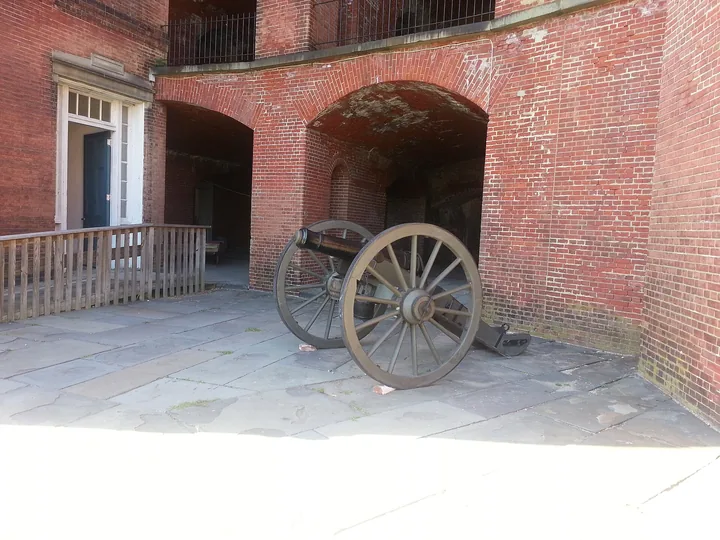
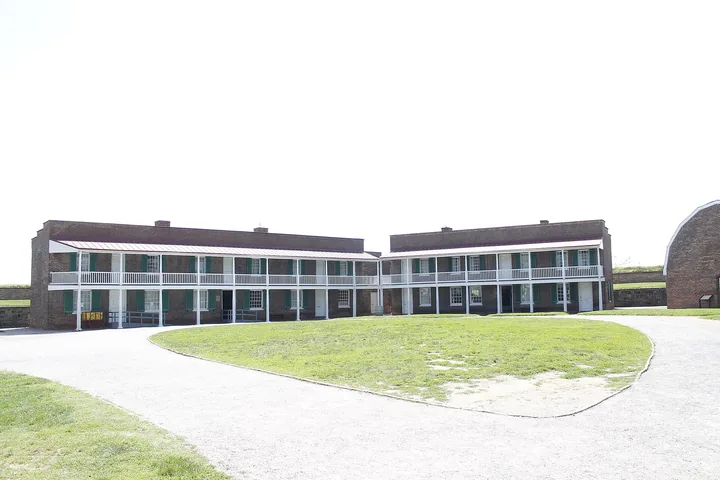
Restored brick buildings around a parade ground: the enlisted men's barracks furnished as in 1814, the junior officers' and commanding officer's quarters, the guard house with its Civil War cells, and the powder magazine a British bomb hit without exploding.
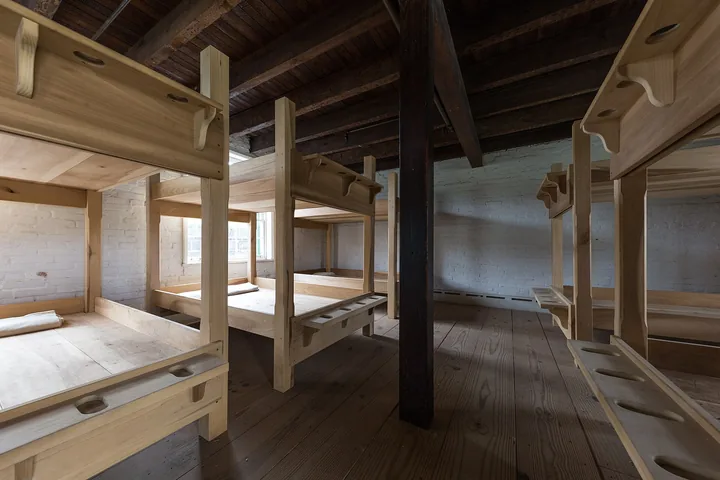
- Barracks: one enlisted men's room is set up with wooden bunks as in 1814; others hold uniform and weapons displays, an electronic map and short videos on the flags and the land battle.
- Commanding Officer's Quarters: the exhibit on Major George Armistead, who ordered a flag "so large that the British will have no difficulty in seeing it".
- Guard house and cells: in the Civil War the fort was a Union prison, nicknamed the American Bastille. After Gettysburg it held 6,957 prisoners at one time, and in 1861 about a third of Maryland's legislature was locked up here, along with Baltimore's mayor and Frank Key Howard, Francis Scott Key's grandson (NPS).
- Powder magazine: in 1814 a bomb crashed into it, with some 200 barrels of powder inside, and failed to explode.
- Ramparts: a brick path runs along the top of the walls on the water side, with the river below.
Other rooms cover the fort's later lives: the World War I Army hospital and the 1930s restoration. About 80% of the brick is original.
Are the cannons at Fort McHenry real?
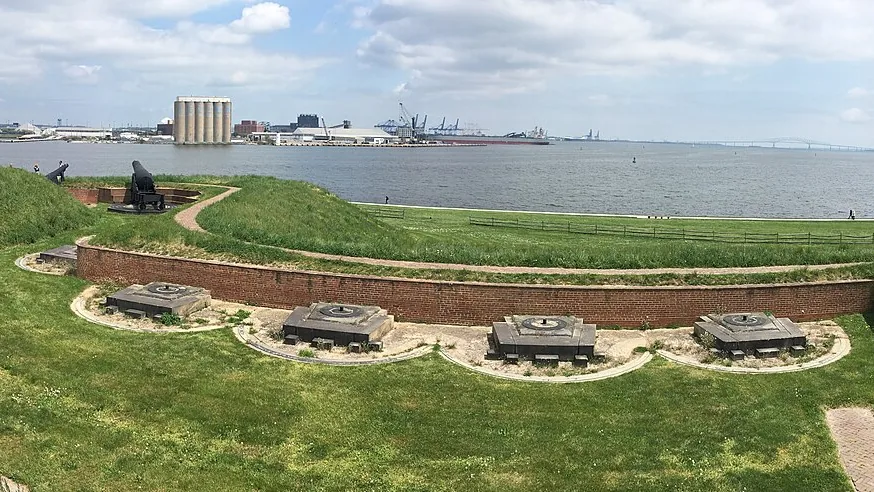
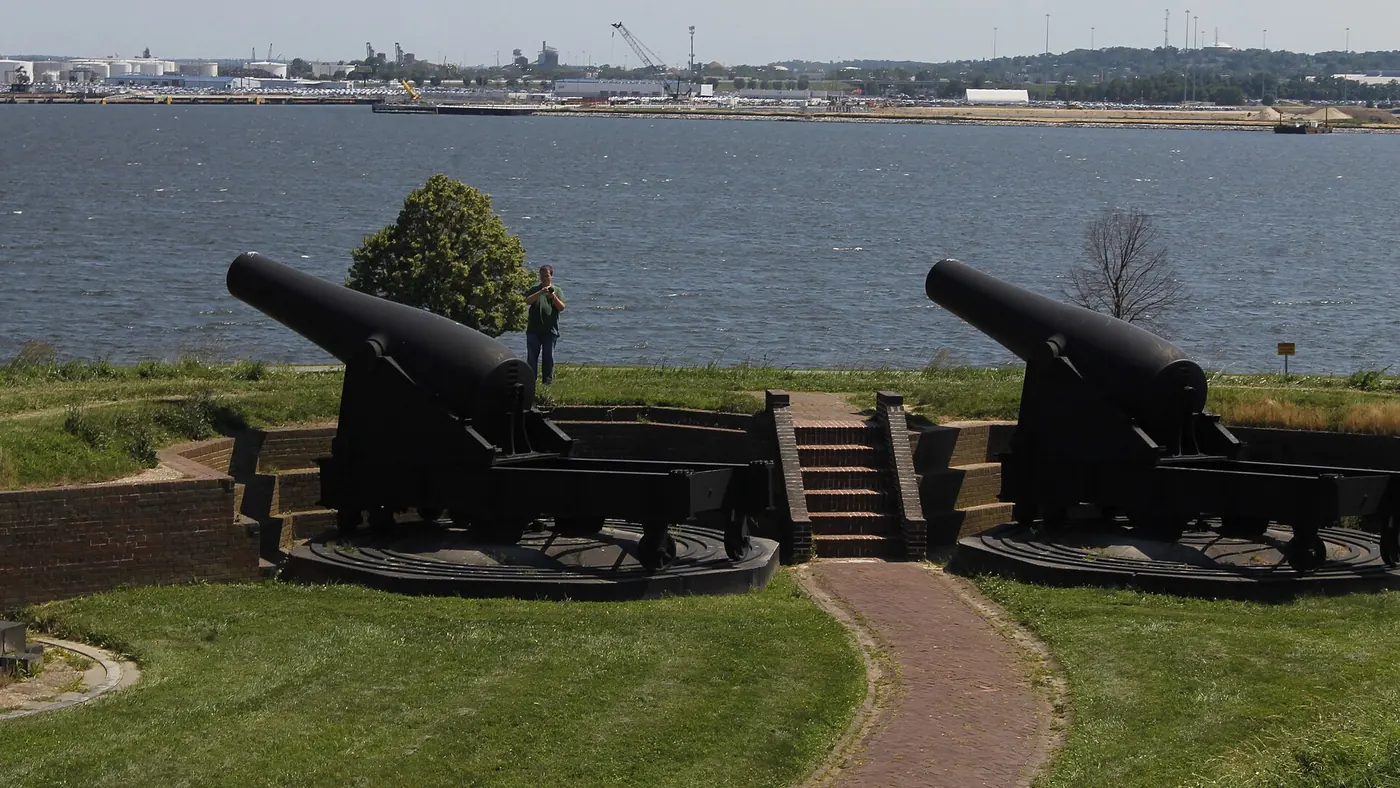
Yes. The big guns on the outer battery are original Rodman cannons in 8, 10 and 15-inch sizes, mounted from 1866 and last fired on 30 June 1903. They are not the guns of 1814.
The Park Service counts Rodmans in three sizes, 8, 10 and 15 inches, all over 150 years old. They replaced older Columbiad guns after the Civil War, which is why the battery looks closer to the 1860s than to the War of 1812. A 15-inch Rodman weighs about 49,000 pounds and threw a ball of 500 to 600 pounds, according to the NPS page for a twin at Fort Foote. None of them ever fired at an enemy: the fort was never attacked again after 1814.
The guns that beat the British sat lower down, in two water batteries along the shore. They mounted French-made 18-, 24- and 36-pounder naval guns with crews of 18 men each and a range of about a mile and a half, which is why the bomb ships kept their distance (NPS). A reconstructed water battery shows how it looked. The story of the battle is in the battle and the flag.
What is the statue at Fort McHenry?
The tall bronze figure is Orpheus, a memorial to Francis Scott Key and the 1814 defenders, dedicated by President Warren G. Harding on Flag Day 1922. A statue of Major George Armistead, the fort's commander, stands by the parking lot.
The rest of the grounds are free and open whenever the gates are:
- Seawall Trail: a paved, wheelchair-accessible loop of about a mile around the point, along the Patapsco River, with cherry trees in spring and views of the working harbor. Trailheads are behind the visitor center, near Orpheus and by the entrance gate. Stay off the stone seawall itself.
- Main Gate: the entrance since 1837, virtually unchanged since the Civil War.
- Chesapeake Bay map: a concrete map behind the visitor center, the meeting point for ranger programs and both audio tours.
- Audio tours: two GPS tours of about 45 minutes in the free NPS App, "Bombs Bursting in Air" (1812) and "American Bastille" (Civil War). Both enter the fee area.
Since March 2026 conservators have been working on the bronze state plaques along the entrance road and the War of 1812 markers in Orpheus Grove, so a few may be fenced off.
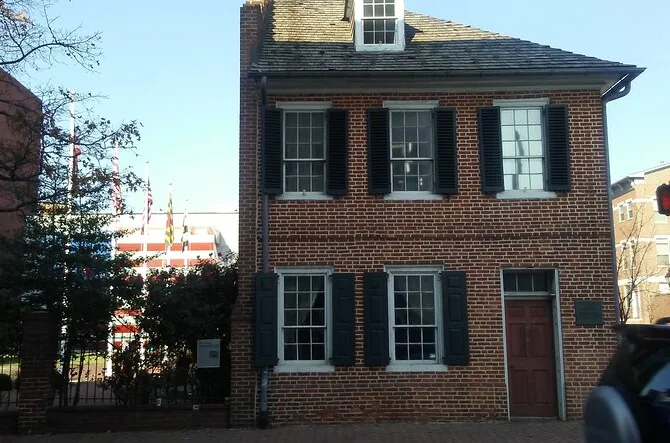
Want the city around the fort too? A local guide drives you through Baltimore's old neighborhoods, ending with 20 minutes here.
Explore the neighborhoods tour with a fort stop Tour detailsIs Fort McHenry good for kids?
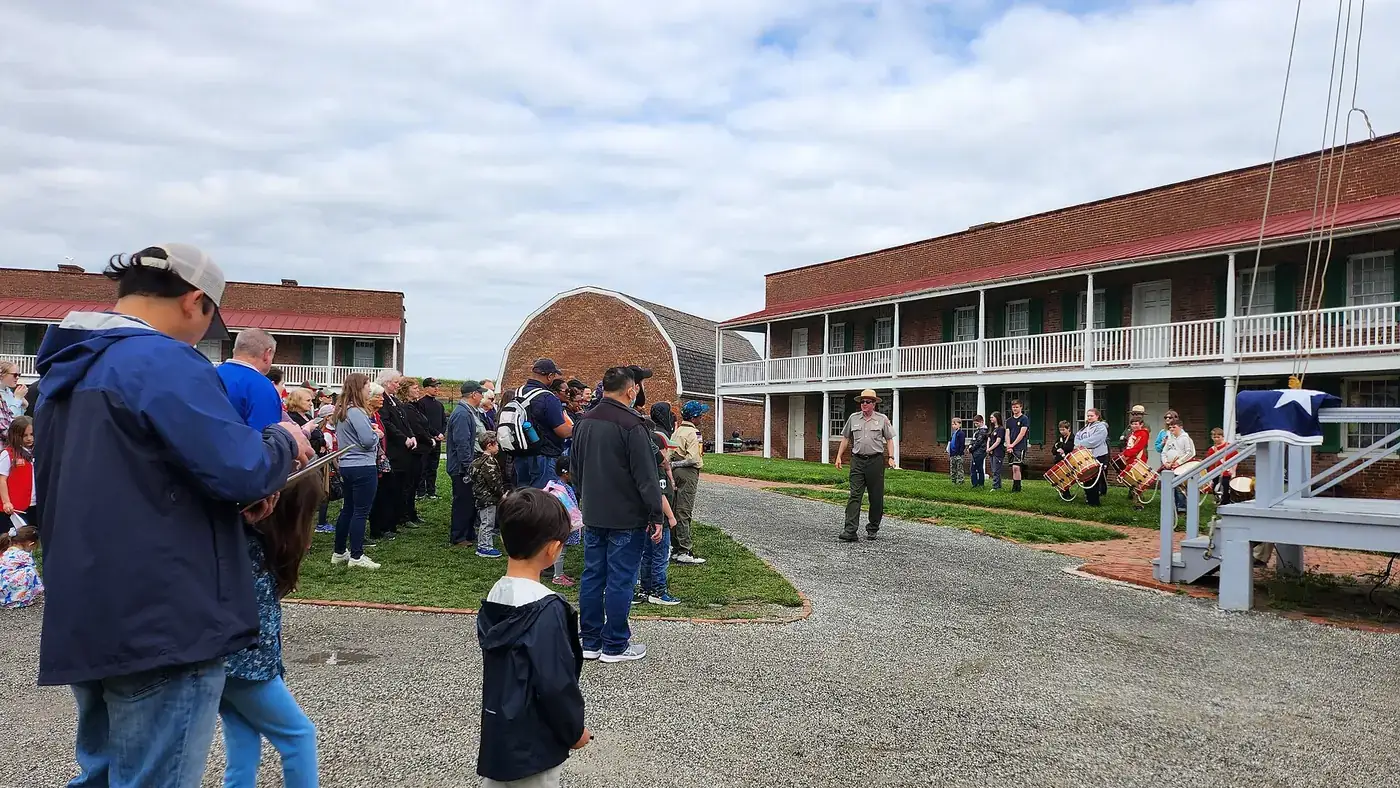
Very. Under 16 is free, the free Junior Ranger booklet (ages 5 to 13, about an hour) ends with a badge and an oath, and children can help rangers with the morning or evening flag change.
- Junior Ranger: pick up the booklet at the visitor center or download it, complete it, and find a ranger to be sworn in. The NPS doesn't mail books, but finished ones can be sent in digitally and a badge mailed, once per person per year. A shorter Star-Spangled Banner Trail booklet takes 30 to 60 minutes (NPS for kids).
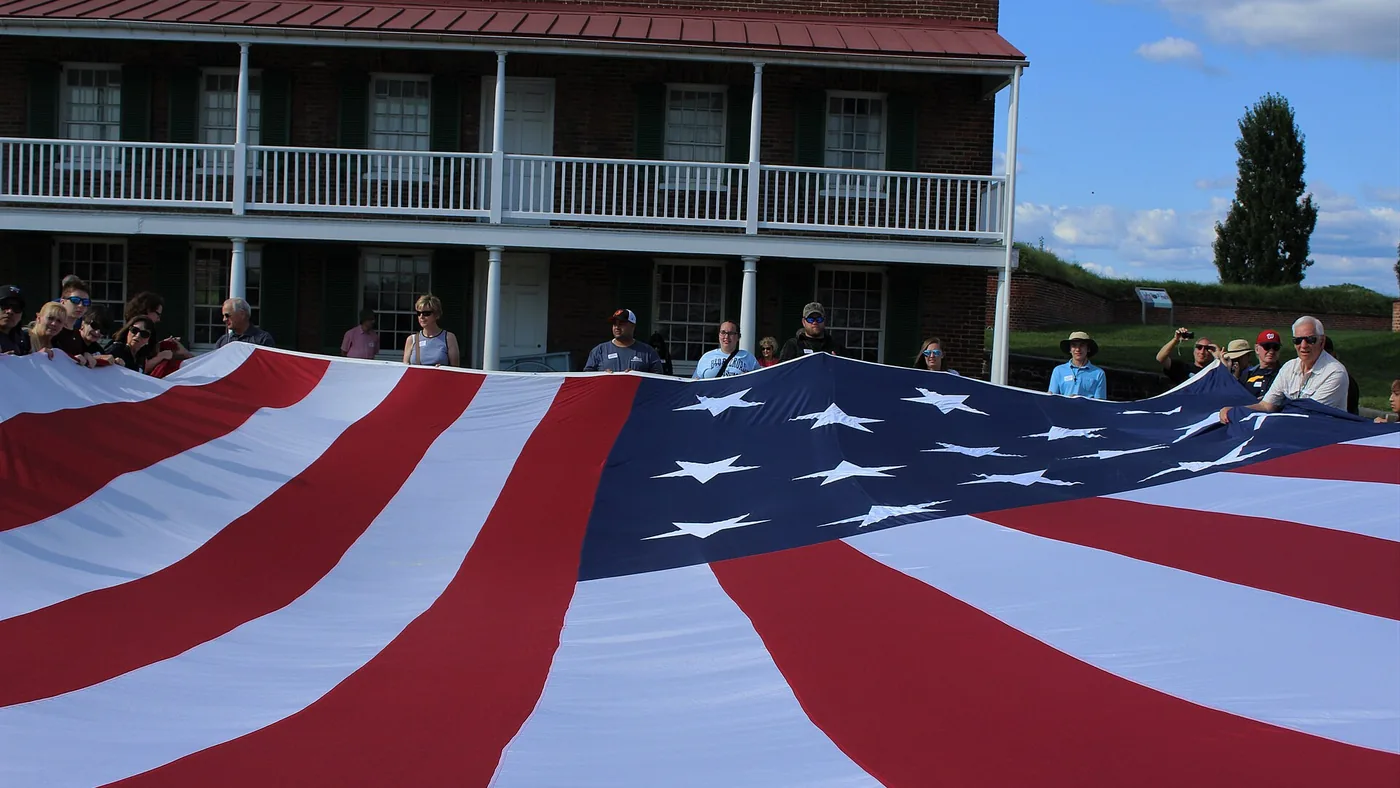
- The flag: kids are often picked to help hold the giant flag at 10:00 a.m. or 4:00 p.m. Be on the parade ground early.
- Summer: cannon and musket firing, fife and drum and period games on weekends; a War of 1812 Fife and Drum Camp for ages 11 and up.
- The film: loud cannon booms and flashing lights. Fine for most, too much for some toddlers.
- A 4th grader in the family? The free Every Kid Outdoors pass covers the child plus 3 adults, so the parents get in free too.
The cells and the powder magazine are small, dark and real, which is exactly what children like. The paved paths work for strollers, and there is plenty of lawn to run on (team sports and frisbees are not allowed).
What facilities are there at Fort McHenry?
Restrooms, water bottle fillers and a gift shop in the visitor center, more restrooms inside the star fort and vending machines outside. There is no restaurant or café.
| Facility | Where | Good to know |
|---|---|---|
| Restrooms | Visitor center (with family restrooms) and inside the star fort | Close 15 minutes before the park |
| Water | Bottle filling stations in the visitor center | Bottled water in the gift shop |
| Food | Vending machines outside the visitor center | No restaurant; bring a picnic |
| Picnic tables | West Lawn, by the Orpheus statue | First come, first served; not inside the historic zone |
| Gift shop | Visitor center | 9:00 a.m. to 4:45 p.m. (5:45 p.m. in summer); 410-625-6170 |
| Wheelchairs | Visitor center desk | Free to borrow |
| Parking | Main and overflow lots | Free, with bus spaces |
Picnic rules: no grills, stoves or fires, no tables of your own, and no tents, hammocks or anything staked into the ground. Drones, fireworks, skateboards and organized games are banned, bags may be checked at the visitor center and fort, and firearms are not allowed in federal buildings. For a sit-down meal, the rowhouse neighborhood of Locust Point starts at the gate.
Is Fort McHenry wheelchair accessible, and can you bring a dog?
Largely accessible: the buildings, exhibits, restrooms, trails and parking are, and the star fort is mostly accessible with some stairs-only spots. Dogs are welcome on a 6-foot leash on the grounds, but not in the fort, the historic zone or any building.
- Access: free wheelchairs to borrow, a Braille brochure, captioned film, exhibits with open captions and audio, and free ASL interpretation if you ask at least 14 days ahead on 410-962-4290 (NPS accessibility). The paved path to the star fort is accessible; some fort buildings and paths are stairs only.
- Access Pass: U.S. citizens and residents with a permanent disability can get the free lifetime pass at the desk. It covers the holder plus 3 adults.
- Dogs: on a leash no longer than 6 feet on the lawns and the seawall trail. Not inside the split-rail fence, the star fort or any building, carried pets included. Service animals are allowed everywhere (NPS pets).
- B.A.R.K. Ranger: dogs get their own activity sheet at the desk; the badge is sold in the bookstore. Keep them well away from summer artillery firing.
The Watermark cruise boards on the Inner Harbor promenade and is listed as wheelchair and stroller accessible.
Check dates for the Inner Harbor sightseeing cruiseFrequently asked questions
Can you walk on top of the walls at Fort McHenry?
Partly. A brick path runs along the ramparts on the water-facing side of the star fort, inside the fee area. Some sections are reached by stairs.
Is the original Star-Spangled Banner at Fort McHenry?
No. It has been at the Smithsonian's National Museum of American History in Washington, DC, since 1907. The fort flies a replica 15-star flag, raised at the 10:00 a.m. flag change.
Can you bring food to Fort McHenry?
Yes, for the lawns and the picnic tables on the West Lawn, but not inside the historic zone. No grills, stoves or tents. Vending machines outside the visitor center are the only food on site.
How long is the Fort McHenry seawall trail?
About a mile: a paved, wheelchair-accessible loop around the point along the Patapsco River. It is free, allows leashed dogs and bikes at up to 10 mph, and has trailheads behind the visitor center, near Orpheus and by the gate.
Ready to book
Choose your harbor trip
Free cancellation up to 24 hours before on every option. Prices are from-prices in USD and move with the season.
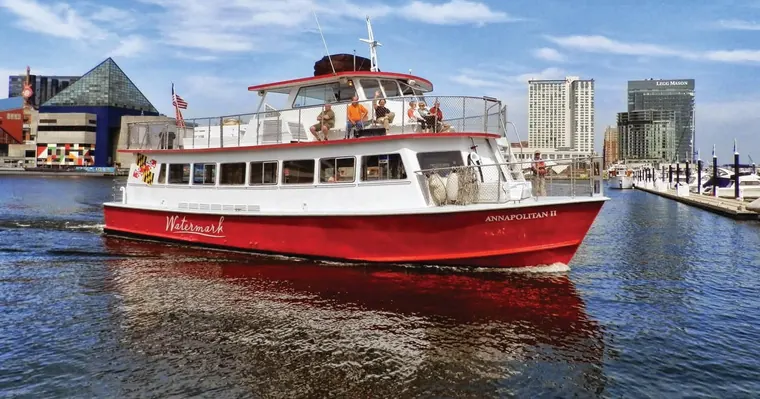
Inner Harbor Sightseeing Cruise
- 45-minute cruise with narration
- Passes Fort McHenry from the water, no stop
- Boards at the Watermark booth, 555 Light St
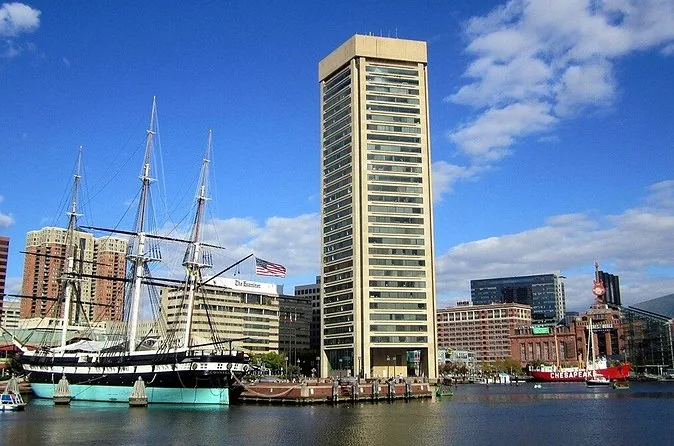
Inner Harbor History Boat Tour
- 90 minutes on the water with a live guide
- Views of Fort McHenry from the water, no stop
- Boards at the Water Taxi dock behind 201 E Pratt St
Small-Group Historic Neighborhoods Tour
- 90-minute guided tour by air-conditioned van
- 20-minute stop at the Fort McHenry visitor center
- Fell's Point, Mount Vernon, Federal Hill and Locust Point